Check Out This Update | Plus, Subscribe To Get Weekly News Roundups

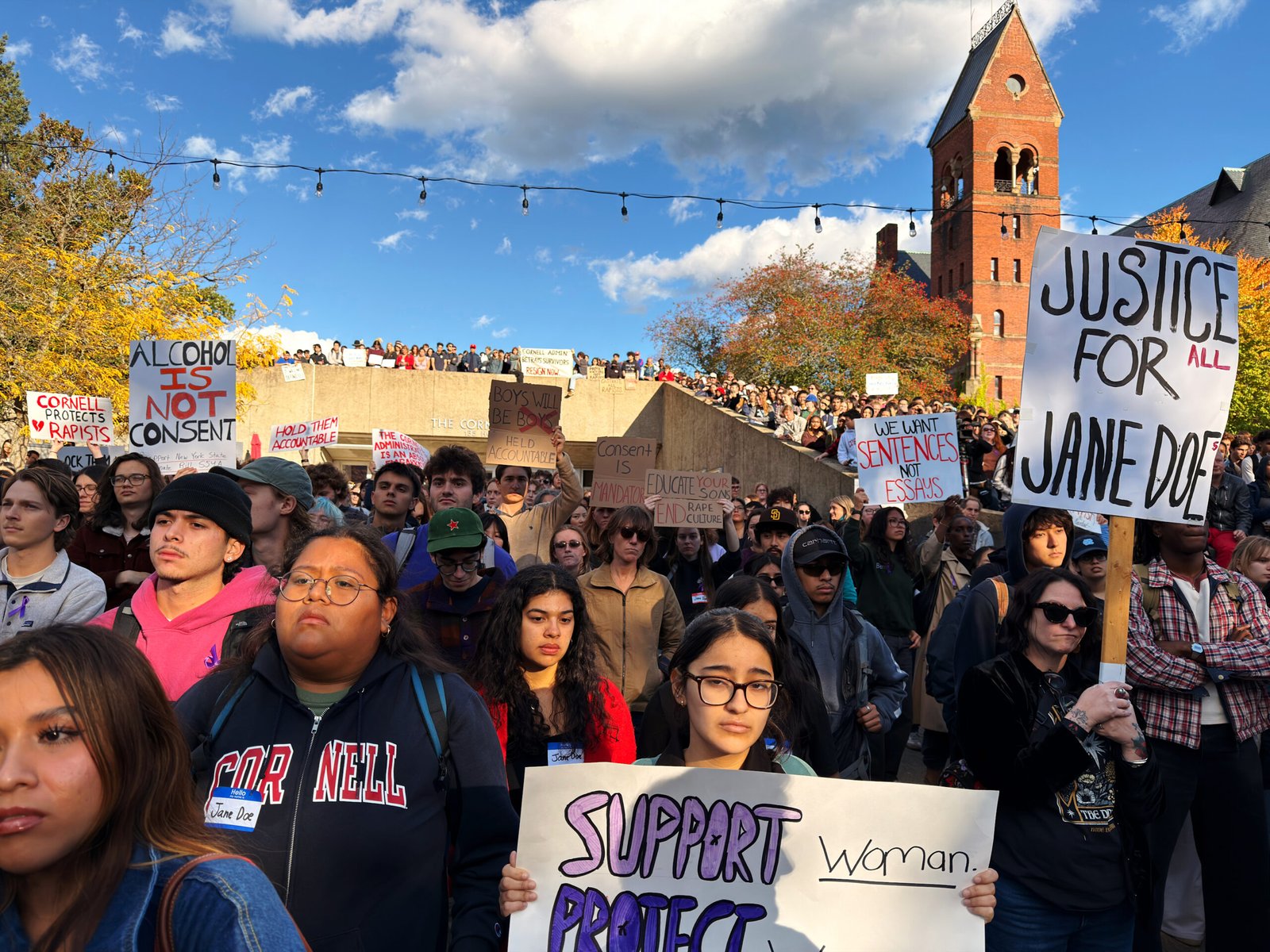

PHOTO: Protest at Cornell University on Oct. 5, 2026. (John4Numbers / Wikicommons)
Warning: This article discusses sexual assault.
An investigation into allegations of drug and rape at Cornell University is being reopened, according to a Sept. 28 press release from Tompkins County District Attorney Matthew Van Houten. Jane Doe, a former Cornell University student, filed a civil lawsuit Sept. 16 against the college and seven male former students on Sept. 16, alleging the seven men, all then members of the Chi Phi Xi fraternity, drugged and raped her repeatedly in 2024.
The DA’s office had originally decided not to file criminal charges against the seven men back in November 2024 after receiving a six-page summary of an interview Jane Doe had with the Cornell University Police Department (CUPD). Van Houten argued that this summary portrayed Jane Doe’s sexual encounter with the seven men as “voluntary, conscious, and consensual,” which was his office’s reasoning for not pursuing prosecution.
News of the lawsuit was first broken by student journalists at The Cornell Day Sun and then picked up by major outlets like The New York Times. Then when additional details began to emerge, Tompkins’ DA’s Office and the CUPD began to face backlash on their handling of Jane Doe’s case, which Van Houten’s argument did not still.
What happened?
According to Jane Doe’s civil lawsuit, the alleged assault took place on the night of Oct. 19, 2024, and into the early morning hours of Oct. 20. On Oct. 19, the then-underage 20-year-old had visited two bars with her Alpha Beta sorority sisters, where she consumed alcohol. By 11 p.m., Jane Doe had “consumed about 10 standard drinks within the past 3 hours,” and was visibly intoxicated when she arrived at the Chi Phi Xi fraternity house to meet a friend who is one of the accused.
Soon after, her friend proposed that Jane Doe engage in sexual activity with one of his fraternity brothers and himself and pressured her into snorting ketamine, which according to American Addiction Centers, can cause disorientation, changes in sensor perceptions and hallucinations. Jane Doe’s friend and his fraternity brother allegedly proceeded to sexually assault her before a third man entered the room and assaulted her. One of the men then reportedly sent a message to the fraternity’s Snapchat group chat inviting other members to engage in sexual activity with Jane Doe. A picture of the message is included in the civil lawsuit. Multiple men are alleged to have entered the room and seven men reportedly poured lines of ketamine on Jane Doe’s body and snorted it before she was purportedly taken to a smaller bedroom and assaulted again by two of the men. By 5:45 a.m. the next morning, Jane Doe lost consciousness according to the lawsuit.
As Jane Doe came to terms with what happened on Oct. 19-20, she reported the incident to the Cornell University Police Department (CUPD) Nov. 8, 2024. That same day, the Chi Phi Xi fraternity and seven accused men were placed under temporary suspension per a University Statement issued by Cornell University Nov. 26, 2024.
On Nov. 14, 2024, Jane Doe was interviewed by CUPD, and in a transcript obtained by CBS News investigative reporter Mahsa Saeidi, told investigators that “I can say with 100% confidence I was raped.”
CUPD then prepared a six-page summary of Jane Doe’s interview for the Tompkins DA Office, which DA Van Houten used to determine that no criminal charges would be brought against the accused. Van Houten later told CBS News New York on Sept. 30, 2026, that he had never seen Jane Doe’s interview transcript, particularly where she said she was raped.
Despite criminal charges not being filed, Cornell started its own Title IX investigation Jan. 14, 2025, reportedly holding at least 12 hearings up until May 29, 2025. Although reports suggested that some of the accused were asked to write essays as punishment after the investigation, Cornell issued a statement Sept. 28, 2026, debunking these claims.
Later on Sept. 29, 2026, Cornell University President Michael I. Kotlikoff clarified that two of the accused were expelled, two were suspended, one already graduated before they could be punished and two were found not responsible of any misconduct.
As for Jane Doe, she left the university in February 2025, according to her attorney, Thomas Giuffra. The Chi Phi Xi fraternity was closed in 2024 and barred from reopening on the university campus.
The lack of criminal charges — and the alleged missteps by elected officials and Cornell itself that Giuffra says were all part of a “cover-up” — has led political actors like Tompkins DA Van Houten, CUPD investigator Jeffrey Northrup, New York Governor Kathy Hochul and New York Attorney General Letitia James to play the blame game.
Subscribe to keep reading
This post is free to read but only available to subscribers. Sign up today to finish reading.
Already subscribed? Log in