Check Out This Update | Plus, Subscribe To Get Weekly News Roundups

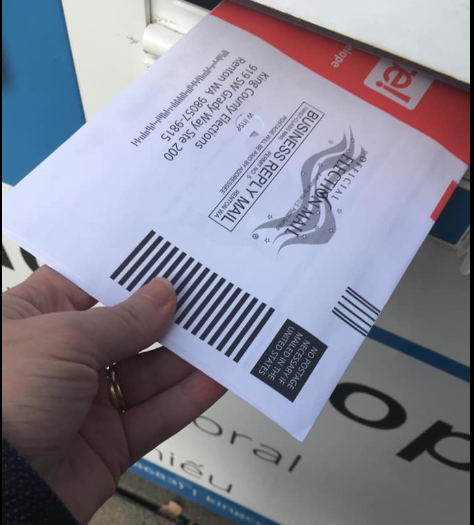

PHOTO: ShanaKFriend – Own work, CC BY-SA 4.0
In less than 42 days, the battle for Congress will conclude with the tally of votes across different states. And while politicos are predicting the outcome and voters are registering to cast their ballots, a recent U.S. Supreme Court ruling makes us question if elections will continue business as usual after 2026.
On Sept. 14, the Supreme Court decided to uphold a lower court block on the United States Postal Service’s new mail-ballot rule in a 7-2 decision. The rule would have introduced new requirements to the mail-in ballot process as directed by President Donald Trump. Judge Indira Talwani of the District Court for the District of Massachusetts placed an preliminary injunction that the Supreme Court refused to overturn, with Trump-nominated Justice Brett Kavanaugh concluding that state and local election officials do not have enough time to execute the rule ahead of the Nov. 3 midterms.
What the majority did not clarify, however, was whether the rule was constitutional— a divergence from Talwani’s decision. That said, although the Supreme Court’s recent decision doesn’t change nationwide mail-in ballot procedures now, implementation of the USPS’ rule in future elections is not out of the question.
What exactly was the USPS’ new mail-in ballot rule?
After Trump signed an executive order in March, where he directed the USPS to make changes to mail-in ballots as part of a plan he called “foolproof” to increase election transparency during a same-day press conference, the USPS responded by finalizing a new rule regarding mail-in ballots Aug. 26.
This new rule would require mail-in ballot envelopes to have the Official Election Mail logo, a barcode unique to each individual voter and an overall design that can be processed automatically by the USPS. Additionally, the new rule would require envelope designs to be reviewed during each election cycle and state and local election officials to upload the name, address and unique bar code of each eligible voter to a federal portal so the USPS will know who to deliver ballots to.
Not only would election officials be able to make changes to the data in the portal at any time, but the USPS would also encourage nontraditional addresses, like college dorms, to be entered in the portal in order for college students to receive ballots in a timely manner.
What happened in the lower court?
Before the Supreme Court decided on the matter, the USPS rule was heard by lower courts and faced varying opinions on its legality.
Three days after the publication of the USPS’ rule, Judge Talwani, who is an Obama appointee, issued a 14-day restraining order barring parts of the USPS’ rule from going into effect. This order was in response to concerns from multiple Democrat-led states and civic organizations that worried the rule would disenfranchise voters and bring confusion to election officials so close to the 2026 midterm elections.
Concurring in her order, Talwani questioned whether the USPS’ rule was constitutional and whether the USPS had the authority to refuse to mail eligible voters ballots unless their state or local election officials complied with the new envelope requirements and submitted each voter’s information correctly into the portal.
Solicitor General John Saur responded to Judge Talwani’s restraining order by requesting the Supreme Court issue a stay, a pause, that would stop Judge Talwani’s restraining order from going into effect. Saur withdrew his request after Judge Talwani replaced her restraining order with a preliminary injunction Sept. 4, which stopped the USPS’ rule from going into effect indefinitely until the outstanding cases against the rule were decided.
A second lower court judge appointed by Trump, Judge Carl Nichols of the District Court for the District of Columbia, issued another preliminary injunction 10 days after Talwani’s. Nichols’ asserted that the USPS’ rule exceeded the USPS’ authority and increased the chance that a “significant number of otherwise appropriate absentee or mail-in ballots” would not be counted.
In an appeal to the Supreme Court again, Saur asked the High Court to block Judge Talwani’s preliminary injunction and allow the rule to take effect ahead of the November midterms.
Saur argued that the USPS’ rule was constitutional and did not infringe on the rights of states to determine who is eligible to vote. He also cautioned that if the Supreme Court did not block Judge Talwani’s preliminary injunction quickly, compliance with the USPS’ rule would remain voluntary and a stay issued too late would carry the “grave risk that States may not have taken the necessary steps to comply” with the USPS’ rule and has the effect of possibly “depriving those States’ citizens of the ability to vote by mail” in the coming midterms.
Taking Saur’s arguments into account, the Supreme Court swiftly denied Saur’s request in its Sept. 14 decision, drawing both opposition and support from government officials. President Trump heavily criticized the Court’s decision in a TruthSocial post and asserted the ruling was “a big loss for Republicans, and America itself” and would make it easier for mail-in ballots to be subject to voter fraud. Supreme Court Justice Samuel Alito, one of the two justices who disagreed with the High Court’s decision, also pushed against the decision, writing in his dissenting opinion that Congress gave the USPS “broad authority to regulate the mail,” including issuing guidelines like its mail-in ballot rule.
How do elected officials feel about the decision?
At the same time, other government officials applauded the Supreme Court’s decision. In a press release, Michigan Governor Gretchen Whitmer praised the High Court’s decision for protecting millions from what the governor called “the federal government’s unlawful attempt to rewrite the rules on mail-in ballots.”
Illinois Attorney General Kwame Raoul said the decision was “a victory for voters, for democracy and for the rule of law in this country” in a Sept. 14 statement. Senate Democratic Leader Chuck Schumer shared a similar sentiment, labeling the Court’s decision as the right one in a public comment.
Yet while the USPS’ mail-in ballot rule might be on bedrest for now, Attorney General Todd Blanche suggested that the Trump administration could pursue other mail-in ballot changes in the future. In a press conference on Sept. 15, Blanche said that the president’s efforts “to make sure that we have free and fair elections are not going to stop just in November or after or thereafter.”
How would a change to mail-in ballots impact Gen Z?
According to a 2025 analysis by The States United Democracy Center, 29% of eligible voters between the ages of 18 and 34 (a big portion of Gen Z) voted by mail in the 2024 presidential election. Put this number side-by-side with a May 2026 analysis by the Center for Information & Research on Civic Learning , which found 49 million Gen Zers are eligible to vote in the 2026 midterms, meaning it is possible that 14 million eligible Gen Z voters could be voting by mail this November.
It is not a surprise that voters including younger ones turn to mail-in-ballots to cast their votes. Since gaining widespread use during the election of 1864 to accommodate Civil War soldiers being away from home, mail-in ballots have become an increasingly popular voting method. For college-age Gen Zers, some might attend universities far from home or out-of-state.
According to the same analysis from The States United Democracy Center, 31% of Americans, over 48 million voters, voted using mail-in ballots in the 2024 presidential election. The USPS’ proposed change to the mail-in ballot process — or any change to the mail-in ballot process for that matter — would have potentially affected just how many Americans vote by mail in the Nov. 3 midterm election, including the number of Gen Z voters.
For now, those 14 million eligible Gen Z voters considering voting by mail do not need to take into account the USPS’ mail-in ballot rule change. Instead, state and local election office websites are key to finding the most up-to-date information about voting registration, mail-in ballot deadlines, early voting, and other critical voting information. Happy voting this November, Gen Z!